
So You Want To Cook More At Home Without Hating It
BLACK IRON RADIO EP. 330: So You Want To Cook More At Home Without Hating It
Cooking more at home is one of the most common goals people bring into nutrition coaching, and one of the most resisted. Most people don't really struggle with knowing what to eat. The friction usually shows up in the execution: planning, shopping, prepping, and doing it all during a busy week.
Brooke, Acacia, and Jess G. talk about how to make cooking more practical and sustainable. The conversation centers on simplifying the process: focus on basic skills, build repeatable meal structures, and learn to cook components rather than complicated recipes. They also dig into common barriers like time, decision fatigue, and the belief that every meal needs to be elaborate. When people stop treating every meal like it needs to be a culinary event, cooking becomes far more manageable
The takeaway is simple: you don't have to love cooking. But building a realistic system around it can make eating well far more sustainable. Consistency, not creativity, is what makes it work long term.
📲 Listen & Subscribe: Apple Podcasts | Spotify
Here's something most people will admit when pressed: knowing what to eat isn't really the problem. The problem is actually doing it. Executing during a busy week, getting food prepped, and not absolutely dreading the whole process. That's where things fall apart.
Brooke, Acacia, and Jess sat down to dig into exactly this. Whether you're someone who loves cooking and just needs a better system, or someone who considers it a necessary evil (Jess is raising her hand here), there's something in this one for you.
Why Cooking at Home Actually Matters
Beyond the obvious financial reasons, cooking at home creates a relationship with your food that eating out just can't replicate. When you're the one measuring, chopping, and seasoning, you learn what's actually on your plate. You understand portions in a way that a restaurant dish served to you never teaches.
There's also a real connection piece to it. When we put our hands on things, we tend to appreciate them more. That appreciation carries over into a more positive relationship with nutrition overall, which is one of the biggest drivers of long-term sustainability.
And if you've ever wondered why your homemade version of a restaurant meal never quite hits the same, now you know: sodium, fat, and people who have been trained specifically to make food taste incredible. Restaurants aren't doing anything magical, but they are basting your chicken in butter in ways you probably wouldn't do at home. That's the secret.
The Most Common Barriers (And Why They're Simpler Than You Think)
When clients tell coaches they hate cooking, the follow-up question is always: what specifically do you hate about it? Because "I hate cooking" usually means something more specific. It might be the prep time. It might be picking overly complicated recipes. It might be the dishes.
A few patterns come up constantly:
Overcomplicating the recipes. People feel like a home-cooked meal needs to be a multi-step production with complex flavor profiles. But a Chipotle burrito bowl is rice, beans, and meat with some seasoning on top. That's it. The bar doesn't have to be Gordon Ramsay.
Thinking they need special tools. You need a sharp knife and a good pan. Maybe two pans: a cast iron and a non-stick. That's genuinely it. A dull knife and the wrong pan create a frustrating experience that makes you want to quit before you've really started.
Fear of failure. What if it doesn't taste good? What if I don't have the right ingredients? These fears stack up fast. The answer is the same for cooking as it is for training: skill is developed over time, confidence comes with reps, and early failures are just part of the process.
You Don't Have to Love It
This is worth saying out loud. You don't have to love cooking. Jess said it plainly: she views it as a necessary evil, and that's okay. Not everyone is wired to find joy in the kitchen the way some people do.
What matters is that you don't loathe it to the point of avoidance. The goal is to make it manageable, repeatable, and not something you dread every single week. That's achievable even if you never become someone who considers cooking a creative outlet.
Acacia, on the other hand, loves the process but hates following recipes because it takes the creativity out of it. She cooks by taste, jots down what she used, takes photos of her spice combinations, and builds her own system from there.
The point: how you work in the kitchen is personal. Getting to know your own style, limits, and preferences is genuinely valuable. Your system doesn't have to look like anyone else's.
Build a Rotation, Not a New Menu Every Week
One of the most practical things you can do is stop trying to come up with something new every single night. Build a rotation of meals that you actually like, know how to make, and that fit your macros. Then cycle through them.
Brooke could tell you her last 365 days of breakfasts. Three to four options on repeat: a scrambled egg omelet, an oatmeal bowl, a peanut butter banana toast, or a waffle fried egg sandwich. The only thing that changes is whether there's salsa, what fruit is on top, or whether cheese makes an appearance. That's it.
Dinners allow a little more variation if that's what you enjoy, but even there, the framework stays the same: a lean protein, a starch, and a vegetable. Think in components instead of cohesive dishes and the whole thing gets simpler fast.
Cook Components, Not Full Meals
This shift alone can change how you think about meal prep. Instead of trying to assemble finished, plated meals every time, cook your components separately and combine them throughout the week.
Cook your protein in a big batch. Have a cooked carb source ready. Then on any given night, you're not really cooking, you're assembling. That protein becomes tacos on Monday, goes over rice on Tuesday, and ends up in a wrap on Wednesday. One cooking session, multiple outcomes.
Jess's version of this is as unglamorous as it gets: brown a ground meat (beef, turkey, whatever), portion it out, microwave a potato, add frozen vegetables. Done. That's a real, legitimate, nutritious meal and there's nothing wrong with it.
Frozen vegetables are still vegetables. A microwaved potato is still a potato.
Grocery Shopping Sets the Whole Week Up
Jess makes her grocery list in order of the store layout and organized by macronutrient category. Proteins in one section, carbs in another, and so on. When she gets home, she knows she has the building blocks for any combination of meals she wants.
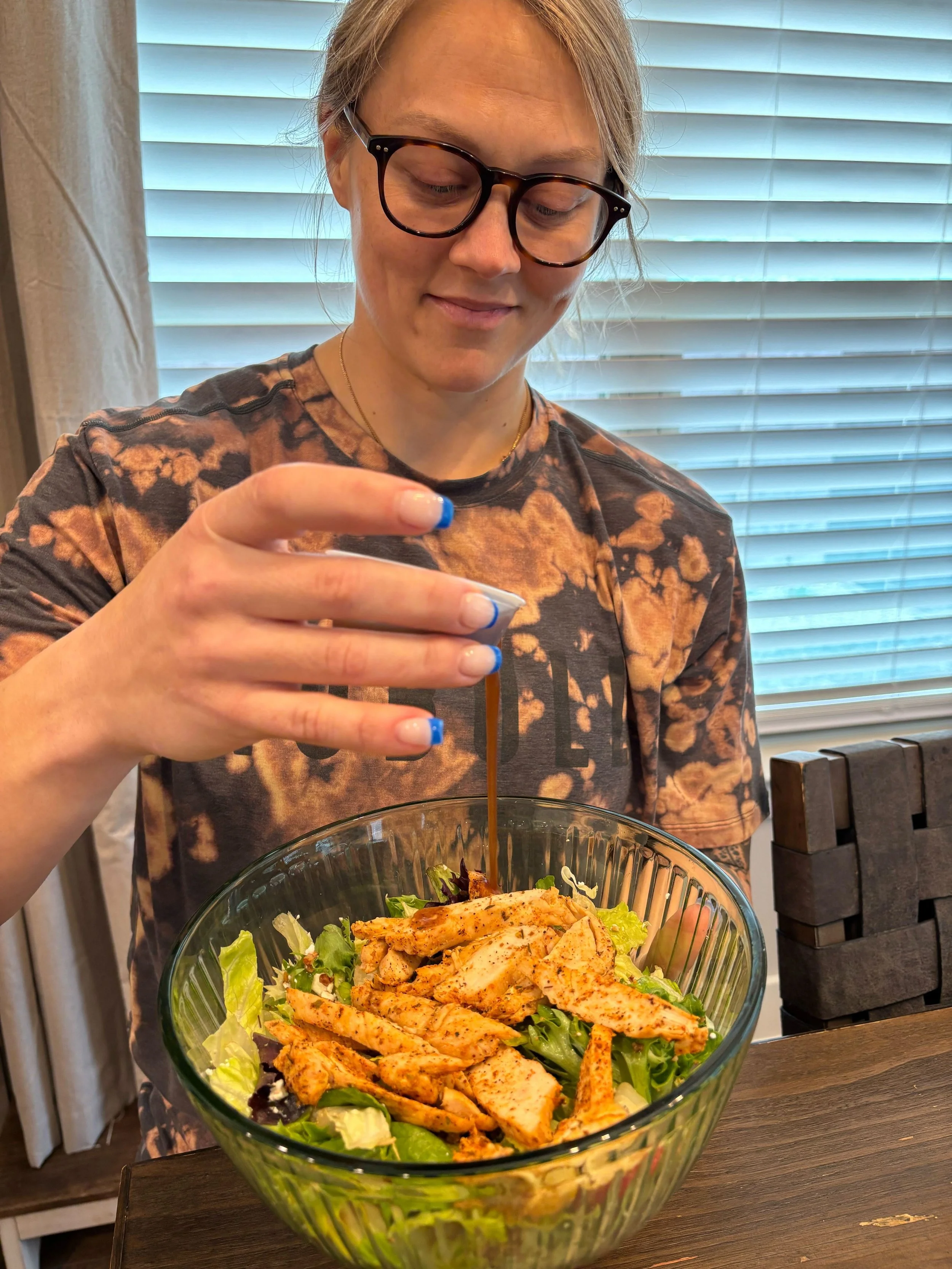
A different sauce can completely change the same base. Chicken and rice with a Greek tzatziki is a different meal than chicken and rice with hot sauce. When you're shopping by component, you have flexibility built in without any additional planning.
Grocery delivery and pickup are also underrated for staying on budget and on plan. Going into the store with a list and leaving with only what's on it is harder than it sounds. Ordering online eliminates the impulse buying and makes it much easier to stick to exactly what you need for the week.
Don't Sleep on Pickled Vegetables
This is a genuine cheat code for adding micronutrients and flavor without much effort. Pickled vegetables don't spoil, they go on pretty much anything, and they add color, flavor, and digestive support to a plate that might otherwise be pretty bare.
If raw vegetables aren't your thing, pickled or fermented options like kimchi, sauerkraut, or pickled beets pack a lot of the same micronutrients in a more concentrated, easier-to-digest form. Toss some pickled onions on your bowl and suddenly a pretty average meal feels a little more intentional.
The Performance Angle
For athletes or anyone with specific performance goals, cooking at home isn't just convenient. It's a competitive advantage. When you prepare your own food, you know exactly what went into it. That precision matters.
Meal prep services can work well, but there are inconsistencies you simply can't account for. When you cook your own meals, you control the sodium, the oils, the portion sizes, and the ingredients. If you're dealing with inflammation, GI issues, or wondering if a food sensitivity might be affecting your training, the only way to really investigate that is to control your inputs. That means cooking your own food.
What you put into your body is just as important as the training itself. Relying primarily on protein bars, shakes, and convenience foods might get you through, but it won't support your performance or your long-term health the way real, home-prepared food will.
Start Here
If cooking at home has always felt overwhelming, the answer is to start smaller than you think. Not a Pinterest-perfect weekly meal prep. Not a six-recipe rotation. Start with one thing you can do consistently.
Batch cook one protein this week. Add a sauce you've never tried. Throw some pickled onions on your plate. Make the grocery list in order of the store layout.
Consistency beats creativity every single time. Build repeatable structure, reduce the decision fatigue, and let the system do the heavy lifting. You might not ever love cooking, but with the right approach, you probably won't hate it nearly as much as you think you do.

🎙️ WANT MORE? SUBSCRIBE TO BLACK IRON RADIO!
If you enjoyed this conversation, check out more episodes of Black Iron Radio, where we cut through the noise and give you real, no-BS advice on feeling, performing, and looking your best. Each week we share practical nutrition, training, and wellness strategies and tips to help you succeed.
📲 Listen & Subscribe: Apple Podcasts | Spotify
