
So You Want to Try Competitive Fitness: CrossFit & HYROX
Thinking about competing in Hyrox or CrossFit for the first time? Both sports have become increasingly popular because you don't need to be elite to compete, and the communities are incredibly welcoming. We're breaking down the key differences between these sports, the mindset shifts you need when going from working out to training to compete, and the most common first-timer mistake. We're also covering nutrition strategy, including how fueling differs between the two sports, why your best competition physique is the one you perform best in, and the importance of practicing game day nutrition. The goal of your first competition is simple: learn, finish proud, and walk away feeling more confident than when you started.
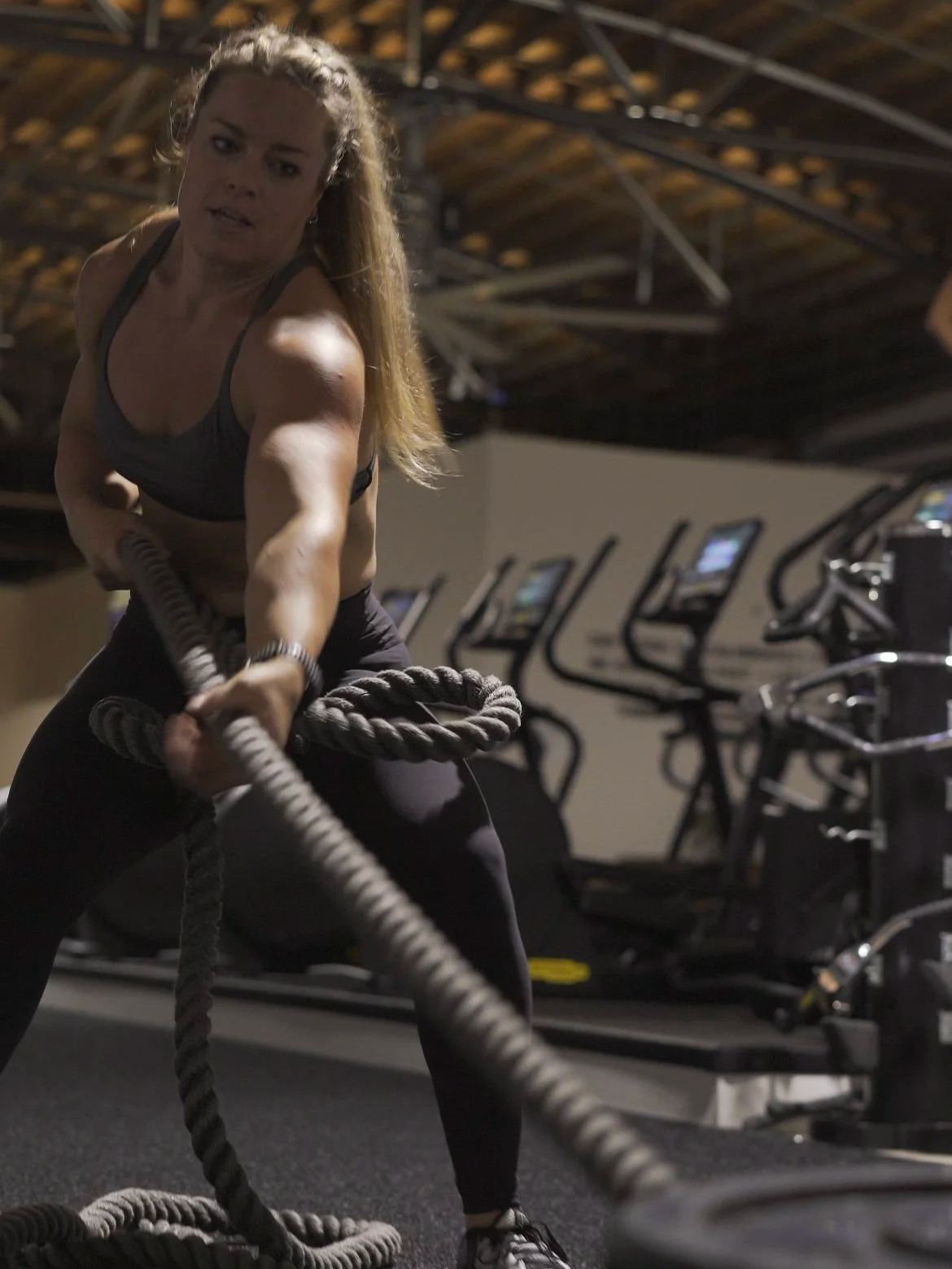
BLACK IRON RADIO EP. 322: So You Want to Try Competitive Fitness: CrossFit & HYROX
Preparing for your first CrossFit competition or HYROX race looks a lot like normal training, just with clearer priorities.
Amanda, Brooke, and Morgan break down what shifts when you move from working out to training for an event. They talk through how CrossFit and HYROX overlap, where they differ, and why most first-time competitors train too hard, too often, without a clear strategy.
They also cover the nutrition side of competition prep for both sports: eating enough to support volume, fueling longer efforts, carb avoidance, and why body composition goals often conflict with performance.
This one's for anyone considering their first CrossFit or HYROX competition and wanting a realistic picture of training demands, recovery, and what matters most when you decide to sign up.
📲 Listen & Subscribe: Apple Podcasts | Spotify
If you're thinking about competing in Hyrox or CrossFit for the first time, you're not alone. Every few years brings a new wave of near-cult-like obsession with a specific sport, and right now, running is having a moment, hybrid training is all the rage, and Hyrox is experiencing the same explosion of hype that CrossFit saw years ago.
While a lot of what we're covering here applies to competing in any sport for the first time, we're focusing specifically on Hyrox and CrossFit because there's significant overlap between them, and we've been getting tons of questions from clients about both.
Let's dig into some honest, practical thoughts, tips, and tricks for tackling your first competition in either of these sports.
Why Are These Sports So Popular Right Now?
The Accessibility Factor
The biggest draw for both Hyrox and CrossFit is simple: you don't need to be elite to compete. Unlike ultra marathons (which sound terrifying on paper), you can walk into almost any gym in the country and see people training in these ways. It looks fun, it looks achievable, and it gets people genuinely excited.
There's a strong sense of community with both sports. The gym atmosphere is typically welcoming and inclusive, even if your intent isn't necessarily to compete. You can participate in these training styles just for fitness, but the option to compete is always there if you want it.
The Marketing Machine
Hyrox has done an incredible job keeping things simple and making it feel accessible to the masses. Everyone in their promotional content is smiling, having fun, and the imagery focuses on teamwork and achievement rather than intimidation.
You can choose to do individual events or team competitions, which makes it feel less daunting. The movements themselves (jogging, picking up kettlebells, using sleds) look like things most people feel capable of attempting, even if they're not currently at that fitness level.
The Class Format Advantage
Unlike training for a marathon (which is very individual and requires you to show up and put in solo work), both Hyrox and CrossFit offer a class setting. You're being told what to do, you have guidance and structure, and you're not alone in the suffering. That community aspect keeps people coming back.
CrossFit's Evolution
CrossFit has been around long enough that it's been "demonized" by some (look at all these injuries! handstand pushups with weight vests!), which can scare people away. But it's also developed a massive, loyal following precisely because of that intensity and variety.
Hyrox, on the other hand, is the shiny new toy. It's fresh, it's exciting, and for people who've been doing CrossFit for a while, it's an easy transition. Hyrox has actually become a really helpful feeder system for CrossFit athletes looking for something different.
Quick side note: Hyrox apparently stands for "Hybrid Rockstar," which... we have some opinions about. But to each their own.
What's the Actual Difference Between Hyrox and CrossFit?
A lot of people think Hyrox and CrossFit are basically the same thing. You might hear someone describe Hyrox as "just a running workout with some CrossFit movements in between." While there's some truth to that, let's clear up the major differences.
Hyrox: The Predictable Endurance Race
It's always the same race. Whether you compete in Cancun, Mexico City, Berlin, or anywhere else, you're doing the exact same course. It's a 1K run between eight different stations:
Rowing
Ski erg
Sled push
Sled pull
Burpee broad jumps
Rowing (yes, again)
Farmers carry
Wall balls
Lunges with sandbag
This repeatability is actually what makes it so appealing. You always know what you're getting, which means you can train specifically for it. You can measure progress precisely (shaving 10 seconds off a station, improving your 1K pace, etc.). It's incredibly measurable, which makes it successful.
The movements are all pretty familiar to CrossFitters, though not every gym has sleds, which might be the biggest accessibility challenge. If you're coming from an endurance background, you'll need to work on those functional movements under fatigue.
Average finish time across all divisions (male and female) is around 1 hour and 35 minutes. So you need to be prepared to move continuously for that long.
CrossFit: The Ever-Changing Challenge
CrossFit is the "unknown and unknowable." You're training to be a jack of all trades, master of none. The workouts change constantly, which means:
You need to be okay with variable workouts, skills, loading, and time domains
There's a higher skill ceiling across more movements
You probably need a more specific gym environment to train effectively
Your weaknesses are constantly being exposed in new ways
It's that adaptability piece that defines CrossFit. Some people thrive on it. Others find it frustrating because progress is harder to measure when you're not repeating the same workout over and over.
Who Thrives in Each Sport?
Hyrox athletes: More endurance-oriented. People who can hurt for a longer period of time (or who enjoy hurting for longer periods). People who like the predictability of knowing exactly what they're training for.
CrossFit athletes: More strength or skill-based. People who adapt well to the unknown. People who can handle variable intensity, time domains, and movement patterns without needing everything mapped out in advance.
The good news: There's enough crossover that if you want to compete in both within a calendar year, that's totally reasonable. One will likely help the other, especially if one sport exposes a weakness that the other sport then forces you to address.
The Mindset Shift: From Working Out to Training to Compete
Regardless of which sport you choose, there's a fundamental mindset shift that needs to happen when you go from working out for general fitness to training to compete.
Willingness to Get Uncomfortable More Often
You need to be able to get out on that competition floor knowing it's not going to be "fun" in the traditional sense. It's more like Type 2 fun: you look back on it and think, "That was really hard, but I'm glad I did it and I enjoyed the challenge."
Just being fit doesn't automatically mean you'll be competitive against others or even enjoy competing. You might get out there and realize, "I'm really fit, but this just isn't for me." And that's totally okay.
You Can't Avoid Your Weaknesses
When you're working out just to be healthy or because you like how it makes you feel, you can mostly do what's fun. You can skip the stuff you hate.
But when you're training to compete, you have to address your weaknesses head-on. Not all parts of your training are going to be enjoyable, and honestly, that's what makes competition day or race day so rewarding. You know you put in the work on those terrible days, on those workouts you dreaded, and you showed up anyway.
That's where the real growth happens. That self-trust you build by setting a goal and following through, by doing the suffering and showing up anyway. That's the magic of competing, regardless of which sport you choose.
Short-Term Sacrifices
Understand that a competitive training block comes with temporary sacrifices:
Prioritizing bedtime over social events
Giving up some social activities
Making nutritional choices based on performance rather than just enjoyment
Structuring your schedule around training
These trade-offs are significantly less when you're just working out to work out. But when you're training with a specific competition goal, those sacrifices become necessary.
Common First-Timer Mistakes
More Is NOT More
This is huge. People think training for hours and hours every single day will make them better faster. It won't.
You should not be doing full Hyrox simulations every week. You wouldn't run a full marathon every week if you were training for a marathon, right? So why would you do a full race simulation weekly?
We see "coaches" (and we use that term loosely) programming things like three half-Hyrox races per week. That's not smart programming. That's a recipe for burnout and injury.
Redlining Every Single Training Session
This is especially common with people coming from CrossFit or with a competitive personality. They walk in, see a workout, and immediately think, "I'm going to crush this unbroken, no matter what."
There's no strategy. There's no thought of "How can I break these wall balls so the next piece doesn't destroy me?" It's just full throttle from start to finish, and the consequences be damned.
Here's the problem with this approach: If every time you train you're redlining and it's miserable and you hate it and you can't finish workouts, your brain starts to protect you from that experience. Your brain doesn't want to feel like that all the time because it feels dangerous.
Over time, your effort will actually decrease. And when you get to race day or competition day, even when you're fully rested and ready, you won't be able to access that upper limit because you have a subconscious protective mechanism in place.
There's enormous value in workouts where you leave thinking, "Yeah, I definitely had more in the tank." Those sessions build confidence. They let you practice good technique. They allow your brain to feel safe pushing hard because it doesn't associate training with constant suffering.
Ignoring Progressive Overload
Your programming should show very clear, very gradual increases in load, intensity, or duration. It should be so obvious that you can look at your training plan and see exactly where the progression is happening.
If you're working with a coach, they should be able to explain the why behind the programming. If you can't see clear direction or progressions, or if it just feels like randomized training, that's a red flag.
Elite athletes can handle high volume because they've spent years building up to it through progressive overload. Don't compare your first-timer training plan to what elite athletes are posting.
Guesstimating Your Current Capacity
Be realistic about where you actually are right now, not where you think you should be or where you want to be. Your programming needs to match your current fitness level and build from there.
Not Understanding Movement Standards
Both Hyrox and CrossFit have judging components. The standards can get a bit wishy-washy depending on who's judging you, but YOU should be holding yourself accountable to the actual movement standard.
Don't practice getting away with questionable reps. Practice doing the movement correctly every single time. You want to feel good about the work you're putting out there, not trick your way through a competition.
The Foundation: Master the Basics First
You can't build a house by laying the foundation and then immediately slapping a roof on top. You have to go through the entire process of building to get to a proficient level of fitness.
For CrossFit specifically: The only way to get to the Games is through the Open. The Open tests the most basic, fundamental movements. If you want to progress in CrossFit, you need to be absolutely excellent at the simple stuff first: air squats, box jumps, power cleans. Master those before you worry about the fancy, complex movements.
For Hyrox: You need a solid aerobic base, you need to be comfortable running for extended periods, and you need to be proficient in the basic functional movements under fatigue.
The glittery, fancy programming that Games athletes post? That's not for you. Following an elite athlete's program doesn't make you an elite athlete. It usually just breaks you.
The Nutrition Piece of the Puzzle
Your nutrition is going to be just as big a part of your competition readiness as the training itself. It's a massive part of your ability to perform and recover well over a long training block.
Common Nutrition Mistakes
Not updating calorie needs. If you're transitioning from CrossFit (short, intense workouts) to Hyrox (longer endurance work with multiple runs per week), your calorie needs have changed. Your output is different. You need to eat more to support that.
Aesthetics over performance. A lot of people think, "If I have the best body composition, I'll have the best performance." That's not how it works. You need to eat enough to support your recovery and training. Carbs are your job now. Nutrient timing matters.
Clinging to old ideas about "healthy eating." When you move into endurance training, the sheer volume of carbs you need goes up dramatically. You might need to incorporate foods you previously thought of as "junk" or "off-limits." Honey Bunches of Oats, Rice Krispies, Pop-Tarts, these become tools in your performance nutrition toolkit.
We have to make some concessions on food quality when we're eating for performance. That doesn't mean abandoning nutritious food entirely, but it does mean being flexible.
Not eating enough on rest days. Your metabolism isn't on a 24-hour clock. Your recovery and glycogen replenishment don't reset at midnight. You need to eat enough even on rest days to support the recovery process. Training is just the stimulus. You only adapt from what you can recover from.
Using competition as an excuse to restrict. We see this constantly: people sign up for a race or competition and use it as their reason to get really strict with training and diet so they can lose weight.
Here's the thing: you can see body composition changes while training for something if you're eating enough to support that training. But if your primary goal is fat loss and you show up on race day feeling terrible because you prioritized getting lean over performing well, that's a problem.
If you want to make body composition changes while training for competition, be realistic about what that will do to your performance potential. A better approach? Do your body composition work in the off-season when you're not trying to peak for a specific event.
Your Best Competition Physique
Your best competition physique is the one you perform and recover best in. Not the one that looks a certain way in photos.
If you're thinking, "I need to drop X pounds so my gymnastics is better," dig into why you think that. Is it actually about performance? Or is it a cover for thinking you need to weigh a certain amount to be athletic or worthy?
Getting smaller rarely means getting more athletic. It almost never means getting stronger.
Fueling Considerations: Hyrox vs. CrossFit
For Hyrox: Approach it more like a half marathon. Higher carbohydrate needs and you’ll likely needing intra-workout fuel if you're going over 75 minutes. Work on gut tolerance during training by intentionally taking in fuel during your sessions.
Important note: You can have fuel on you during the race, but someone can't hand it to you. You need those little zipper pouches in your shorts or leggings with gels or whatever works for you. Practice this in training. Figure out what you can stomach while running that won't melt or be disgusting to eat.
For CrossFit: Easier to structure because you have breaks between events. You can have a concrete plan: pre-competition meal, pre-event one, immediately post-event one, what you're doing between events based on timing, etc.
The challenge with CrossFit is that heat times can change depending on how well the competition is run. But generally, you have more opportunity to actually sit down and eat between events.
The Hyrox timing challenge: You often don't get your heat time until close to race day. You might be standing in the corral for two hours before your start. Or you might be assigned an 8:30pm heat with a time zone change. This makes pre-race nutrition a bit more ambiguous.
The good news? Hyrox is short enough that as long as you do right by your nutrition in the week leading up (your taper), eat solid food the morning of the race, and maybe have a gel or two on you, you're probably going to be fine.
Practice Game Day Nutrition
This cannot be overstated. Practice eating at different times of day during training. If you always train 8-11am, your body adapts to that schedule. Your metabolism, your glycogen shuttling, your nervous system, all of it becomes more efficient at that specific time.
If you're a morning training person and then you have to race at night, that's going to feel significantly harder both physically and mentally. That's not weakness. That's your body being your body.
For multi-day events (more common in CrossFit): Your nutrition on day one matters. What you eat that night matters. What you eat the morning of day two matters. Work with a coach to dial in the whole structure around that.
Should You Actually Compete?
If you're on the fence about whether you're ready, here's what to consider:
Green Lights
Your life is relatively stable. You're not going through major financial changes, relationship upheaval, job transitions, or moves. When your whole life is uncomfortable, adding the discomfort of serious training can be too much.
You're at peace with your mental health. Only when you're in a good place mentally should you introduce the added stress of competition training.
The timing makes sense. If you're a school teacher, don't sign up for a late August/early September competition. Pick a time of year when you can actually commit to the training without your life falling apart.
You want to challenge yourself. You're genuinely interested in seeing what you're capable of, not just trying to force an outcome.
The Right Mindset
Go in with the intention of completion, not winning. Make this a positive experience from the start. You're trying to do something hard, and that's enough. You don't need to podium to make it worthwhile.
Do it right or don't do it. If you look back at your training and think, "I trained more times less than not" or "I feel really unprepared" or "This was completely unsustainable," then something went wrong. You should walk away from competition feeling like you had fun, you were challenged in unexpected ways, and you want to do it again.
Competition can be your North Star. A lot of people need a goal, and fitness is an excellent outlet for that. Having that competition date on the calendar can help other areas of your life fall into place. It gives you purpose and structure.
The Bottom Line
CrossFit and Hyrox are both extremely accessible sports with welcoming, largely inclusive communities. Competing can be empowering, humbling, affirming, purposeful, and challenging in all the best ways.
It's important, especially at first, to compete with a growth mindset: "I might not be my fittest or strongest just yet, but I work really hard, I want to challenge myself, and I'm proud of what my body and brain can do. I can do hard things."
You don't have to podium for it to be worth it. You don't even have to love it or want to do it again. The goal of your first competition should be to learn and to finish proud.
The training is the hard part. The competition is the reward.
If you can walk away feeling accomplished, feeling fitter and more confident than when you started, and hopefully wanting to do it again, that's a huge win regardless of your actual placement or time.
So if you're on the fence: do it. Sign up. Commit to the training. Show up on race day. You'll learn something about yourself either way, and that's always valuable.
Ready to train for your first competition with proper nutrition support? Check out our coaching services at Black Iron Nutrition. We work with athletes across all sports to dial in their nutrition for performance, recovery, and competition readiness.
🎙️ WANT MORE? SUBSCRIBE TO BLACK IRON RADIO!
If you enjoyed this conversation, check out more episodes of Black Iron Radio, where we cut through the noise and give you real, no-BS advice on feeling, performing, and looking your best. Each week we share practical nutrition, training, and wellness strategies and tips to help you succeed.
📲 Listen & Subscribe: Apple Podcasts | Spotify
