
Rewriting the “Summer Body” Story
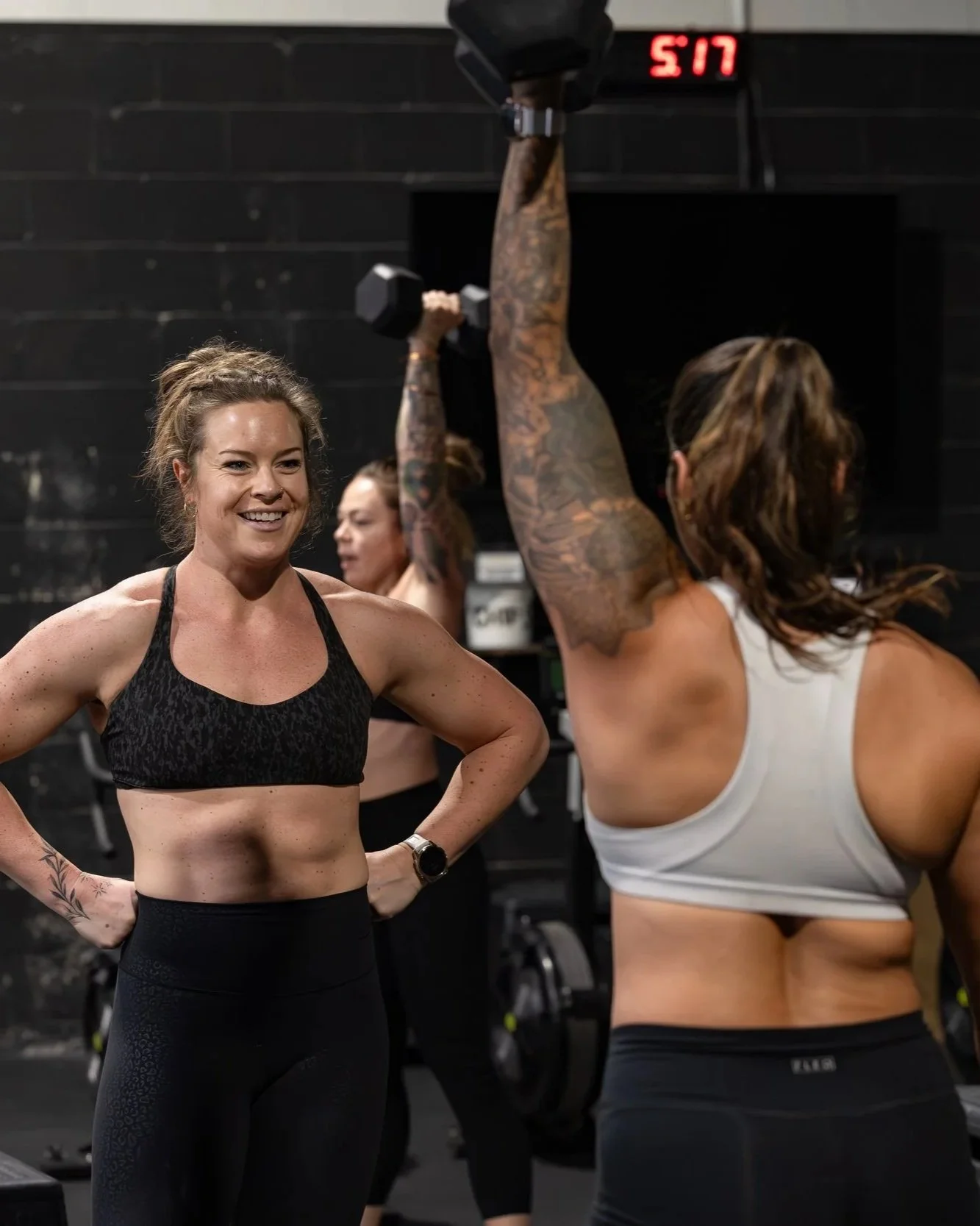
BLACK IRON RADIO EP. 357: Rewriting the “Summer Body” Story
Every year around this time, without fail, the summer body messaging is in full-force. The "last chance to lose 10 pounds before beach season" ads, paired with the implication that you have to earn the right to be seen in a swimsuit. It is the same story in different packaging, and it has been going on since your grandmother was worried about her waist size.
Amanda, Kelsey, and Sabrina talk about where that messaging actually comes from, why it sticks, and why hitting the number you have been chasing is almost never the thing that makes you feel better. They get into the negative feedback loop, the self-talk red flags, anchoring bias, why nobody at the end of a vacation remembers what anyone looked like in a bikini, and why BIN stopped running summer challenges.
You are allowed to have goals. This episode is just about making sure the story driving those goals is actually yours.
Every year, right around this time, the algorithm comes for you. Suddenly your feed is full of summer shred programs, last-chance weight loss tips, and beach body countdowns. The messaging is relentless, and it has been for generations. It just comes in different packaging now.
In this episode of Black Iron Radio, Amanda, Kelsey, and Sabrina talk about why the summer body story is one worth rewriting, what crash dieting actually does to your body and your brain, and how to build the kind of confidence that doesn't expire in September.
What Is the Summer Body Story, Exactly?
At its core, the summer body story is the idea that you have to earn the right to be seen. That your body has to look a certain way before you're allowed to put on a swimsuit, wear shorts, or show up fully to the warm months you actually get so few of.
The problem isn't your body. The problem is the story you've been convinced to believe about it, repeatedly, across your whole life.
This isn't new. The coaches talked about how the messaging spans generations: grandmothers fixated on their waist size, mothers passing along self-deprecating habits without meaning to, and then the same narratives absorbed quietly by daughters who didn't even realize it was happening. Now we have social media on top of all of it, plus the fact that we're seeing ourselves more than ever before. Phones, mirrors, workout videos, tagged photos. We're consuming our own reflection in a way humans simply weren't designed for, and then we wonder why we're picking ourselves apart.
The seasonal pressure makes it worse. Summer feels like a deadline, and the messaging treats it like one: you haven't done enough, you ate too much over the holidays, and now you're running out of time.
Why Crash Dieting Before Summer Almost Always Backfires
One of the most common things that comes up in coaching this time of year is the panic hire. Someone reaches out in April or May wanting to lose 10, 15, 20 pounds before vacation. And while the desire to feel good is completely valid, that’s not an approach we would ever take with our clients. Here’s why.
The psychological cost is enormous. When you're in an aggressive calorie deficit for weeks, your mental real estate gets consumed by food. You think about what you can't have. You plan what you'll eat when the diet is over. Your mood tanks because you're chronically underfueled. Social anxiety spikes because every event becomes a logistical problem: What's going to be there? Can I eat it? Am I going to blow my plan?
And the confidence you were hoping to build? It becomes fragile. Not stronger. Kelsey described it perfectly: your confidence becomes like glass. One comment, even a neutral one, can shatter it entirely.
The physiological cost compounds over time. This is the piece a lot of people miss. Every calorie deficit isn't just a standalone event that ends when you reach your goal. Repeated cycles of aggressive restriction teach your body to down-regulate energy expenditure. Your resting metabolic rate, your spontaneous movement throughout the day, your output during training: all of it can decrease as your body works to conserve energy.
What that means in practice is that every subsequent fat loss phase gets harder, even if you're eating the same or fewer calories. It truly does get more difficult every time you run this cycle.
Your hunger and fullness hormones get disrupted too. Ghrelin, the hormone that signals hunger, and leptin, the one that signals fullness, both adapt during prolonged restriction. You end up feeling hungrier, less satisfied after meals, and more fixated on food, and those effects don't always disappear when you go back to maintenance.
For women especially, reproductive hormones are sensitive to sustained low energy availability. Irregular cycles or a missing period are signals that something is off, but many people on hormonal birth control miss that feedback entirely, which means the stress on the body can continue undetected.
The cycle feeds itself. You restrict hard before summer. Summer arrives with its barbecues and vacations and drinks on the beach, and you either white-knuckle through all of it or you let go, overeat, and end the season feeling like you failed. Then fall comes and the guilt sets in, and by the time the holidays are over, you're ready to start the cycle all over again.
Each pass through that loop makes the next one harder. That's not a moral failing. It's just physiology.
If Crash Dieting Won't Build Confidence, What Will?
Confidence is not a size, and it's not something you earn by hitting a certain weight. Confidence is built through self-trust. And self-trust is built exactly the way trust in any relationship is built: through showing up consistently, keeping the promises you make to yourself, and giving yourself credit when you do.
Sabrina put it this way: the most confident people you know know who they are. And that sense of self gets built by making promises to yourself and keeping them. Not perfectly, and not without stumbling, but consistently enough that you start to actually believe in yourself. When you break a promise, it's not the end of the world. You just show up and prove it to yourself again.
The Self-Talk Piece
The way you speak to yourself is your most constant influence. It shapes your habits, your behavior, your identity, and how you move through the world. If you're running a loop of "I'll feel good once I lose these 10 pounds" or "I'm never going to look right in a bathing suit," your brain treats that as instruction. That becomes your reality.
Shifting that doesn't have to start with loud positive affirmations. For a lot of people, going straight to "I look amazing" feels hollow and lands as false. A more useful entry point might be something like "my legs look strong today."
Kelsey shared that her coach once gave her a daily habit of standing in front of the mirror and saying one positive thing about herself. At first it was things like "I like how my eyelashes are curled today." That's it. But the practice built on itself, and over time it genuinely shifted how she talked to herself.
Sabrina's recommendation for people who are more naturally negative in their self-talk: start even earlier than positivity or neutrality. Start with noticing. Just observe how you're speaking to yourself without trying to change it right away. That awareness alone is the beginning of the shift.
And one question worth asking when the inner critic gets loud: would you say this to your sister? Your daughter? A close friend? Most people wouldn't. The gap between how we talk to others and how we talk to ourselves is often enormous, and recognizing it is a place to start.
What This Looks Like in Practice
Breaking the cycle doesn't require giving up your goals. You're allowed to want to change your body. You're allowed to have aesthetic goals or performance goals or fat loss goals. None of that is off the table.
What we’re pushing back on is the idea that shame is a useful starting point for any of those things. Shame creates an all-or-nothing relationship with food and movement. It drives avoidance of social situations, rigid food rules, extreme plans that are inherently unsustainable, and a pass/fail relationship with your own body that makes maintenance nearly impossible.
The alternative isn't body love at all times no matter what. It's body neutrality. It's a baseline of respect and care for your body in every season, not just when it looks a certain way. It's the recognition that your body is allowed to change throughout your life and that's not a failure, it's just life.
And practically? Wear what you feel good in now, not what you used to wear or what you think you should be able to wear. Go to the pool party. Be in the pictures. Eat the food. Check in with yourself at the end of the day and ask what you actually remember. If the answer is the laughs and the people and the conversation, that's data. If the answer is the calorie math you were running in your head the whole time, that's also data, and it points toward the internal work that needs to come first.
Amanda said something toward the end of the episode that is worth closing on: "The best summer body is not the smallest or the leanest body in the room. It's the body attached to someone fully participating in their life."
You don't need a different body to deserve a good summer. You just need a kinder story to tell yourself about the one you already have.
🎙️ WANT MORE? SUBSCRIBE TO BLACK IRON RADIO!
If you enjoyed this conversation, check out more episodes of Black Iron Radio, where we cut through the noise and give you real, no-BS advice on feeling, performing, and looking your best. Each week we share practical nutrition, training, and wellness strategies and tips to help you succeed.
