
When we talk about performance nutrition, the conversation tends to center around calories, protein, carbohydrates, and hydration. It makes sense: these are foundational focuses independent of sport of choice. But behind the scenes of all of those big-picture nutritional needs are some tiny powerhouses: micronutrients. These are the vitamins and minerals that help your body to produce energy, build and repair tissue, support immune function, maintain bone health, transport oxygen, regulate fluid balance, and adapt to training.
Every human regardless of activity level should probably put some intention around micronutrient intake, but for athletes, micronutrient status is especially important. Turns out, active populations are at greater risk of micronutrient deficiencies. Athletes aren’t necessarily automatically deficient just because they exercise, but training can increase the body’s demand for certain nutrients while simultaneously creating more opportunities for them to fall short.
So what is a micronutrient, and where do we get them from? Essential nutrients are nutrients your body cannot make in sufficient amounts, so you must obtain them from food (or, in some cases, supplements - more on that later!). They include essential vitamins, minerals, essential fatty acids, and essential amino acids, and are required for normal health, metabolism, growth, and recovery. Non-essential nutrients can be produced by the body in adequate amounts, so they do not have to come directly from your diet, although consuming them through food may still provide health or performance benefits since athletes tend to be at higher risk for nutrient deficiencies because training increases both nutrient demands and nutrient losses. Repeated training and recovery means a higher rate of energy metabolism and expenditure, tissue repair, red blood cell (RBC) turnover, sweating, muscle function, and bone remodeling. These all require additional nutrients above and beyond the requirements of a more sedentary population. At the same time, chronic low energy intake (accidental or intentional), restrictive or specialized diets leading to limited food variety due to preferences or leaning on “safe foods,” or just not eating enough to match training AND recovery demands can make it difficult to meet those micronutrient needs. It is very possible to eat what most would consider a “healthy diet” while still having major gaps in micronutrient intake!
Iron is a classic example. Endurance training increases oxygen demand and red blood cell turnover, which increases the body's demand for iron in order to produce hemoglobin and support oxygen delivery. If dietary iron intake doesn't keep up with that increased demand - and the athlete is also losing some iron through sweat, GI losses, and/or increased RBC turnover - iron stores can gradually decline. Especially compounded over time, this can impair oxygen transport, reduce performance, and contribute to fatigue both in and outside of training. These negative effects can be felt even before full-blown iron-deficiency anemia develops.
Focus on Food Diversity Before Supplements
If you want to improve your micronutrient intake, the best place to start is not a giant, expensive supplement stack! Food variety is the primary name of the game. Different foods provide different combinations of vitamins, minerals, antioxidants, phytonutrients, and other bioactive compounds that are important for your performance, recovery, and general health. The more diverse your diet, the more opportunities you have to cover your nutritional bases.
A well-rounded diet should regularly include colorful fruits and vegetables, whole grains and various starches, legumes, nuts and seeds, dairy products (or fortified alternatives), a variety of protein sources from both land and sea. You don’t need to eat to stress eating entirely different foods every single day; the goal is just to shift food choices here and there to create diversity across your week(s).
Remember that whole food comes along with a unique profile of micronutrients, water volume, macronutrients, and fiber in some cases. All of these things in combination help your body to use the food components most efficiently, and affect how one food’s components interact with another, and within your body. Iron is good example here as well. Heme iron from animal-based products is the most bioavailable form of consumed iron, but you can absorb iron from non-heme, plant based sources as well, especially if you are aware of what you are taking in alongside that food source. Eating non-heme plant sources (like spinach or lentils) in a complete meal alongside vitamin C-rich foods (like bell peppers or citrus fruits) significantly increases absorption.
Supplementation as a sole means of micronutrient intake kind of misses the broader goal of optimal systemic health and function! Also keep in mind that the supplement market is largely unregulated. You cannot be certain that what a company claims you’re buying is exactly what you’re consuming on both the supplement ingredients and dosing side of things.
That said: a “whole food first” approach doesn’t mean “all supplements are bad.” Supplements can absolutely have a place in sports nutrition, especially if you have a known deficiency that is not being - or cannot be - resolved by diet intervention. Supplementation is appropriate when an athlete has a clinically confirmed deficiency, has increased needs that are difficult to meet through food alone, or has a dietary restriction that makes certain nutrients difficult to obtain.
The problem comes in when there is blanket supplementation without knowing whether you actually need it. More is NOT always better. Some nutrients can accumulate in the body, interfere with other nutrients, or cause adverse effects when consumed in excessive amounts. And remember: taking a multivitamin or handful of individual supplements doesn’t necessarily compensate for a diet lacking overall food quality and variety.
This is where labs can be useful. If you’re concerned about a potential deficiency, test rather than guess, always! Bloodwork can help identify whether there is an actual problem that warrants intervention. Not every athlete needs iron, vitamin D, magnesium, B12, or something else simply because they’re an athlete! This is particularly relevant for nutrients such as iron and vitamin D, where deficiency can be common in athletic populations but supplementation should ideally be based on individual circumstances and appropriate testing.
Labs are not perfect and shouldn’t be interpreted in isolation - symptoms, diet, training load, medical history, and other factors all matter - but they can provide much more useful information than blindly adding another bottle of supplements to your rotation. Labs should always be ordered and interpreted by a medical profession, and of course, always consult with your medical doctor before addressing a clinical need with a supplement!
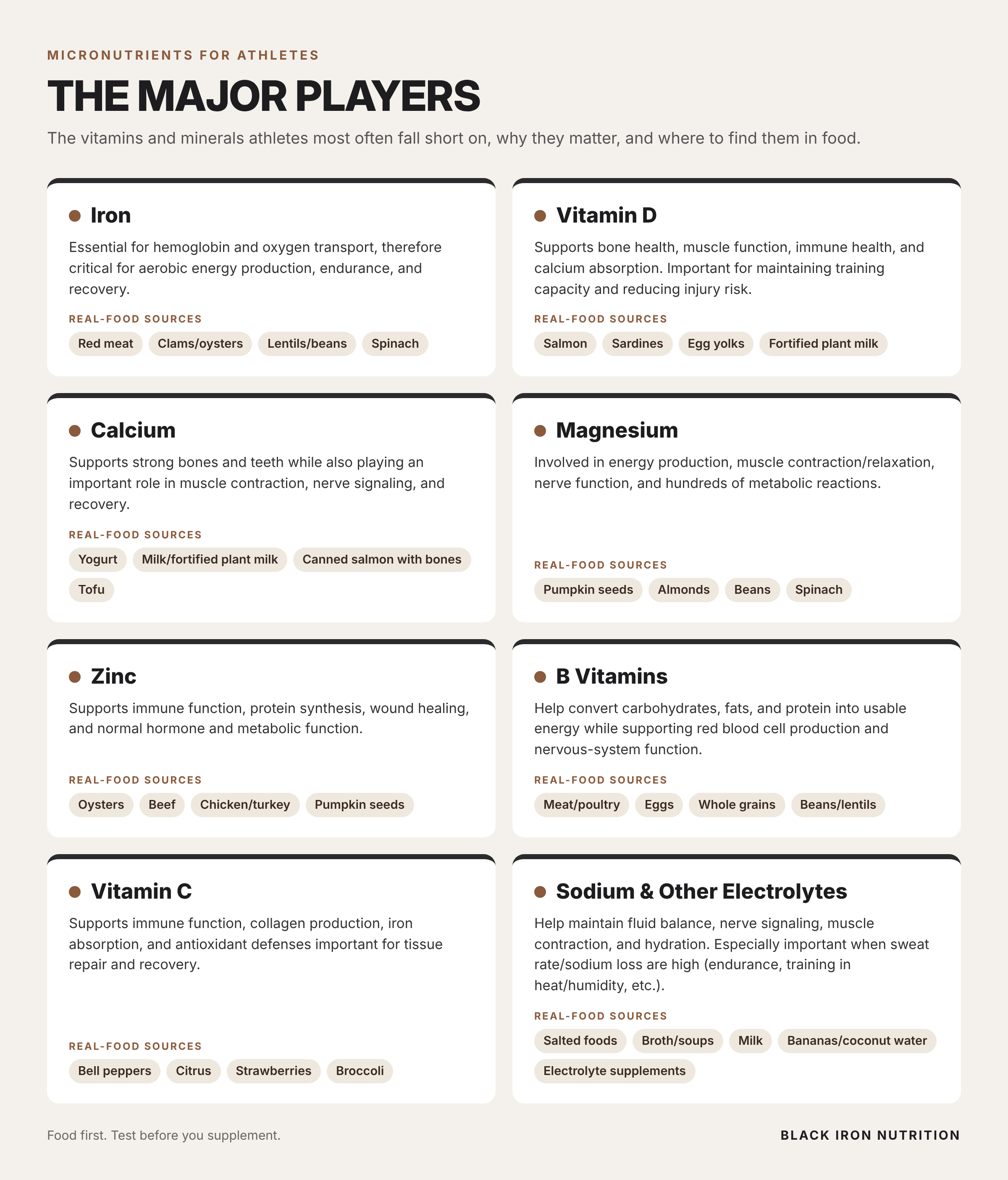
Here are some of the major players athletes are prone to deficiency in and what to prioritize in your diet to avoid falling short:
The Bottom Line
Micronutrients may be small, but their roles in athletic performance, recovery, adaptation, and general health are big time! For most athletes, the best strategy to ensure adequate micronutrient status is going to be to eat enough, eat a wide variety of foods and to rotate food choices on a somewhat regular basis. Prioritize nutrient-dense whole foods and use supplements strategically (ideally under medical direction) when there is a reason to use them.
